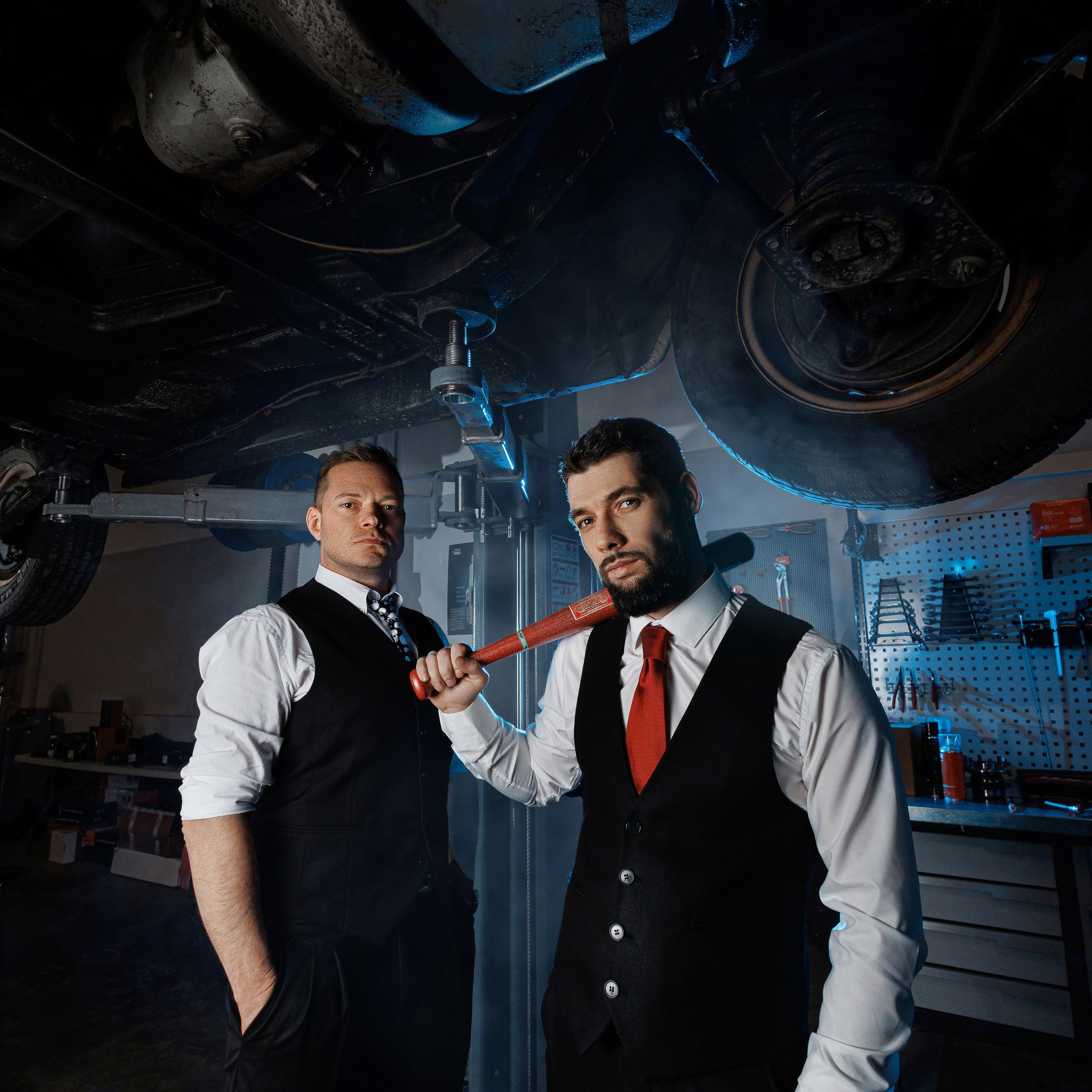
Production photography differs from every other kind in that the conditions matter more than the photographer. In a studio you control everything. On a factory floor you control almost nothing: there’s little light, the ceilings are high, the floor may be live, people are in hard hats and respirators, and half the machinery can’t be shown.
And yet a production facility is the most convincing asset a company has. A plant, a machine, a line, people at a conveyor prove scale in a way no copy can. “We’ve been trading since 2004” is words. A frame of a workshop where the line fills half the image is a fact.
Below: what to shoot, how to solve the technical problems, and what has to be agreed before you unpack the kit.
An honest caveat
Safety comes before the frame. No photograph is worth asking someone to take off their hard hat, stand on a moving conveyor or step up to a running machine. That isn’t caution — it’s the rule. On a production site the photographer follows the same instructions as the employees, and if a frame requires breaking them, there is no frame.
A second caveat, about security. Most production sites don’t allow you to shoot everything: there are restricted areas, other people’s products, process secrets, equipment under NDA. This is settled before the shoot, not discovered on the day when half the frames are already taken and can’t be shown.
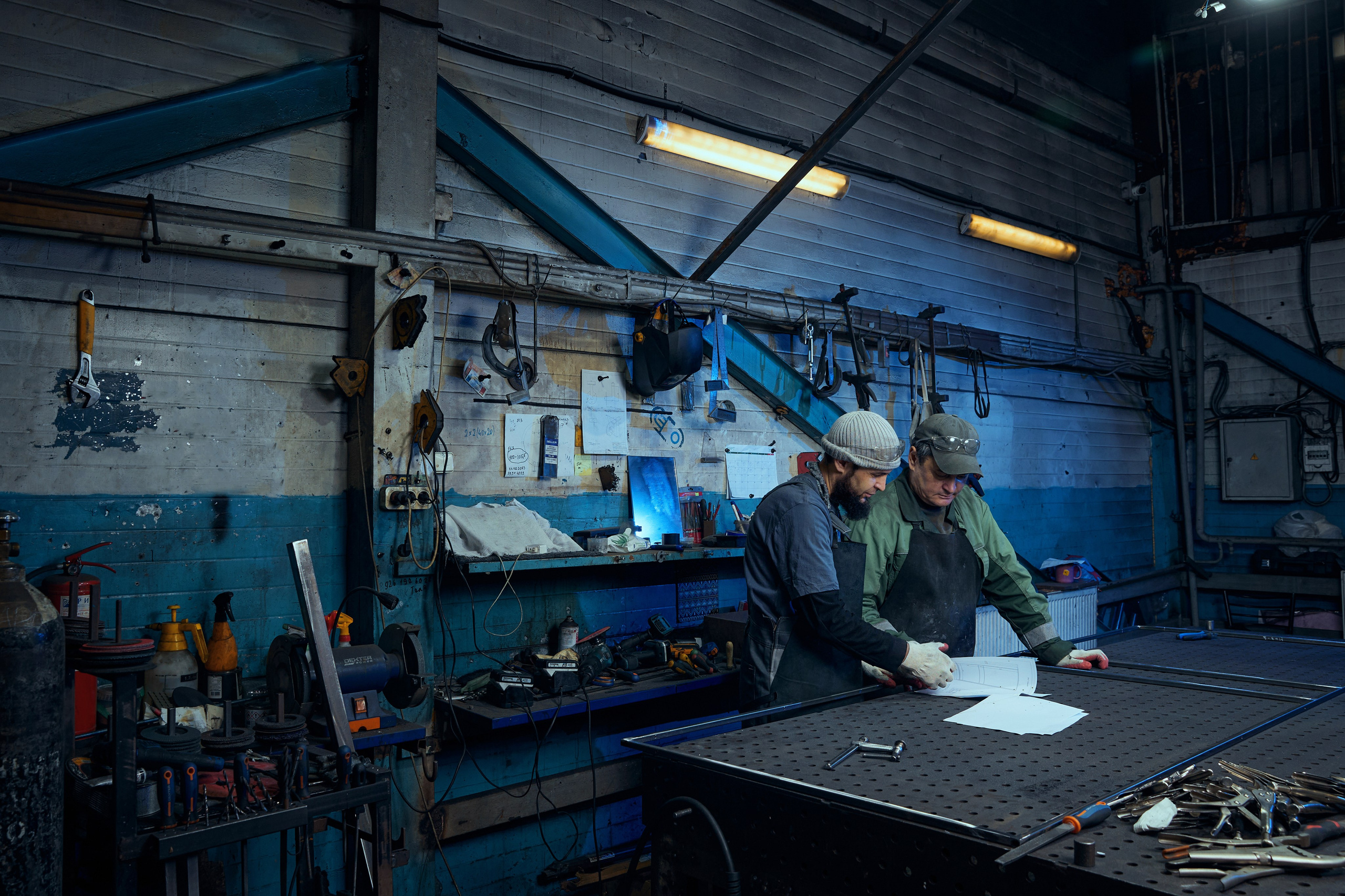
What to shoot on the floor
A production set differs from a corporate portrait set in that the subject is the process, not the person. But it doesn’t work without people either: an empty workshop looks like an abandoned one.
| Shot group | What it proves | Where to use it | How to shoot it |
|---|---|---|---|
| Wide view of the floor | the scale of production | home page, presentations, tenders | wide angle, down the long axis, all lighting on |
| Machinery in close-up | the standard of equipment and tooling | services page, advertising | from the side, no reflections, machine running |
| People at work | that real specialists stand behind the output | website, social media, careers page | mid-operation, not posing, in full PPE |
| Operations and hands | precision and skill | social media, presentations | macro: gloved hands, tool, component |
| The product | what you actually make | catalogue, product pages, advertising | finished goods, including packaged |
| Details and textures | care in the work and the material | social media, covers, backgrounds | metal, swarf, cut edge, weld seam, texture |
| PPE and safety | that health and safety isn’t a formality | careers page, tenders, internal materials | visors, helmets, floor markings, guards — as they are |
Technical conditions: where shoots fail
A production site is a set of technical constraints to be solved before the shoot rather than during it. Here are the most common, and what to do about them.
| Condition | What the problem is | The solution |
|---|---|---|
| High ceilings | ceiling light doesn’t reach the people or the machines | powerful strobes on tall stands, light from above downward |
| Mixed light sources | discharge lamps go green, sodium lamps go orange | overpower with flash, choose a shutter speed that avoids banding |
| Dust and swarf | flies into the frame, settles on the lens, leaves spots | change lenses rarely, shoot long, pick the moment between operations |
| Metal and glass | reflect everything, including the operator and the lights | polarising filter, shoot at an angle, use a diffusion panel |
| Cramped space | nowhere to put a tripod, no two metres from the machine | wide lens, shoot from the wall, a single-source setup |
| Noise and heat | hard to work in, limited time available | a shot list prepared in advance, short bursts, breaks |
| Stopping the line | halting production for a frame is costly or impossible | shoot during operation, catch the moment rather than arranging it |
A note on light specifically. On a factory floor there’s usually plenty of it and it’s unusable: bright, but from above, hard, and with wild colour casts. So the first thing to check on site isn’t “how much light is there” but whether the existing light can be killed. If it can’t, the flash has to overpower it — which means power and stands, not “I’ll fix it in post”.
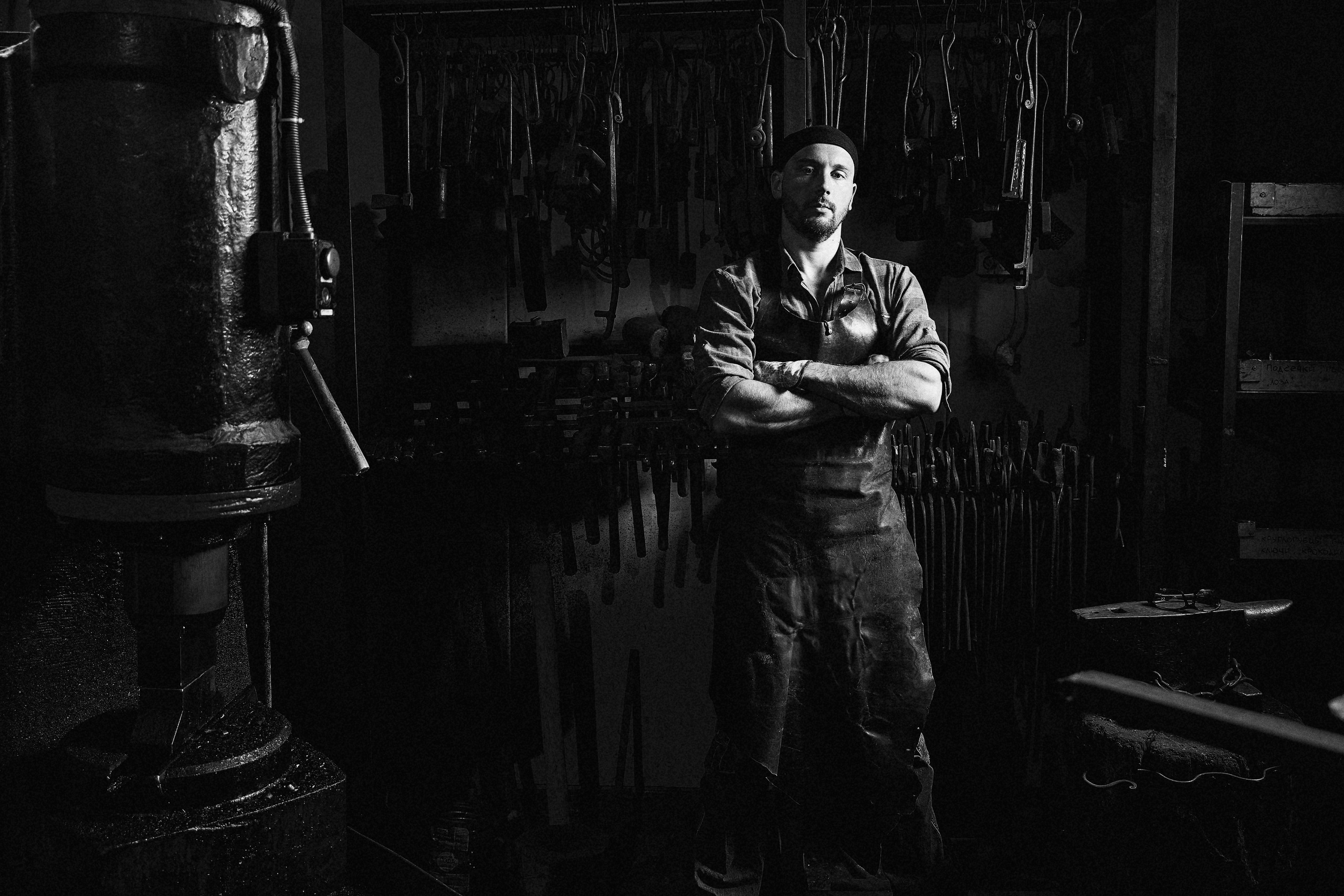
People in PPE
This is the hardest part of industrial photography, and the most underrated.
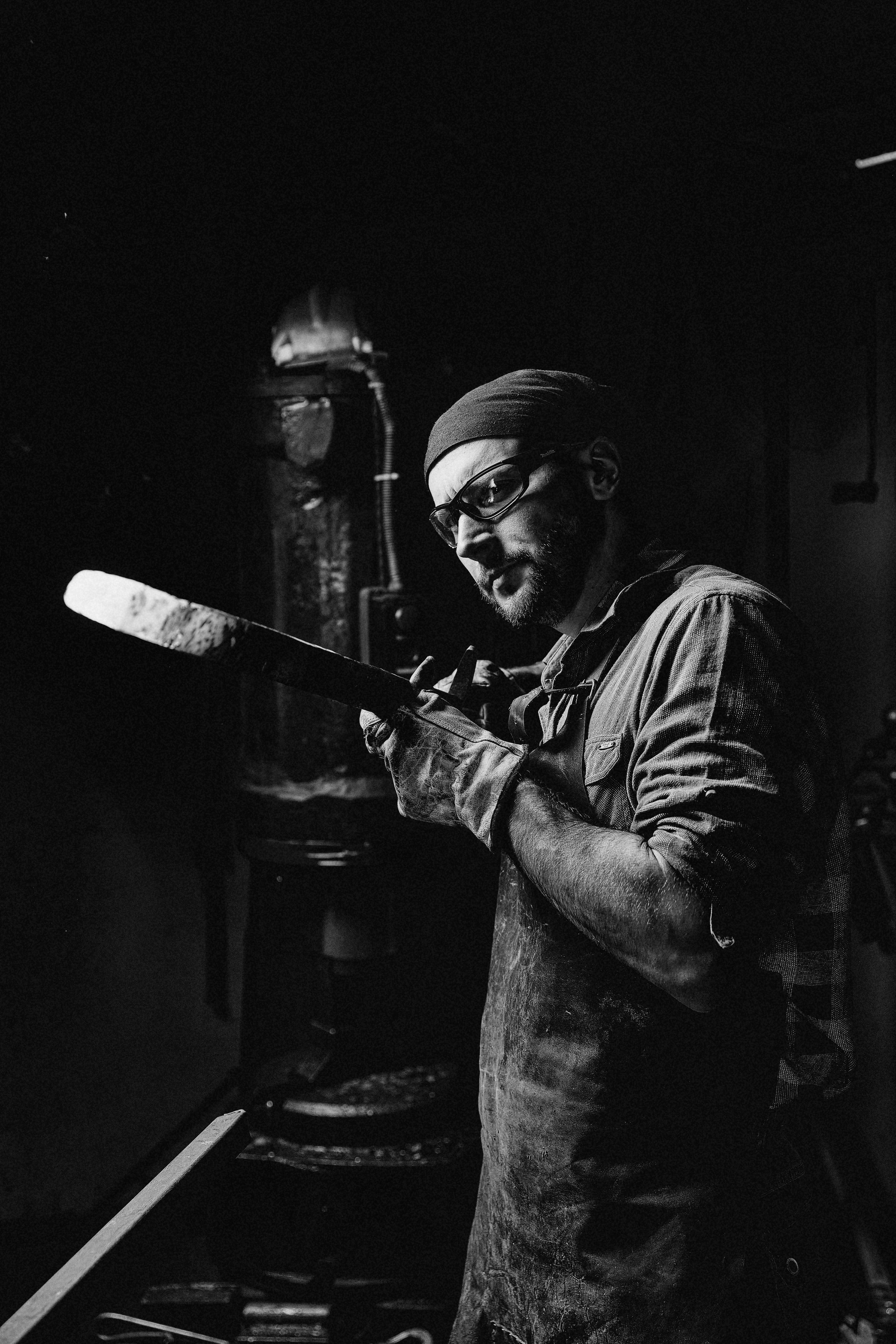
PPE works against a portrait: a hard hat covers the head, a respirator covers half the face, goggles throw highlights, gloves remove the hands. What’s left is an anonymous figure — and what you need is for the frame to read “this is Oleg, he’s been here twenty years and knows that machine like the back of his hand”.
What helps:
The eyes. If the face is covered, the gaze does the work. Shoot so the eyes read: the turn of the head, the direction of the look, the moment he glances toward camera.
Posture and gesture. Leaning over the machine, a hand on the lever, the angle of the body — that is the characterisation when you can’t see a face.
The moment of concentration. Someone absorbed in the work is more expressive than someone posing in a hard hat. Shoot when they’re not looking at the camera.
A medium shot instead of a close-up. If the face doesn’t read, a close-up emphasises the failure. A medium shot shows the person in action, and the failure stops mattering.
Hands. Gloved, yes — but hands are still the most honest thing in the frame.
One person against the whole floor. Sometimes the strongest frame isn’t a portrait but a small figure in an enormous space. It speaks about scale, and about how much the plant depends on its people.
And one absolute: don’t ask anyone to remove PPE for a photograph. Not only because it’s dangerous, but because the falseness shows: a person without a hard hat in a workshop where everyone wears one reads as a setup, and trust in every other frame drops with it.
Approvals: what you need before the shoot
More shoots fail here than on light or composition. A production site is a controlled facility, and without preparation you won’t get past the gatehouse.
| What you need | Who to ask | How long it takes | Without it |
|---|---|---|---|
| A site pass | security or the access office | 1–3 days | you won’t get past the gatehouse |
| Permission to photograph | management and security | from 3 days | frames can’t be published even if shot |
| Health and safety induction | the H&S officer | 20–40 minutes on site | you won’t be admitted to the floor |
| A PPE kit | health and safety | issued on site | helmet, hi-vis and safety footwear are mandatory for everyone |
| An escort | the production manager | for the whole shoot | you can’t move around the floor alone |
| Employee consent | the employees themselves, in writing | collected in advance | frames with people can’t be published |
| A list of restricted areas | security | request it with the permission | some frames will have to be deleted |
FAQ
How long does a shoot on a factory floor take?
An hour or two for the induction, changing and rigging, then the shoot itself at production pace. Over one shift you can realistically assemble a full set for a single workshop — provided the shot list is ready in advance.
Can we photograph people without their consent?
No. Written consent to publish has to be obtained before the shoot. If someone declines, shoot them from behind or don’t shoot them at all — on a production floor it’s rarely noticeable, because everyone is dressed the same.
What if the workshop is dark?
Bring light. Don’t try to rescue it in post: noise and crushed shadows don’t come back, and a workshop full of grey faces convinces nobody. One or two powerful sources plus a diffuser will solve most of it.
Do we need to stop production to shoot?
Almost never. A working floor is more honest and more expressive than a stopped one, and stopping costs money. The exception is if you need machinery photographed in full, motionless — that’s planned separately.
How do we shoot equipment that’s under NDA?
Shoot the wide views, the people, the hands, the details and the product, avoiding the restricted assemblies. This often gives you more: a room and its people say more about production than a nameplate with a model number.
Can we just use a phone?
For social media and internal materials, sometimes. For the website, tenders and advertising, no. On a factory floor the phone fails on light rather than sharpness: mixed sources produce green and orange casts that can’t be corrected.
What if we need the shoot urgently and approvals won’t clear?
Then there’s no shoot. Site access isn’t a formality: a photographer without clearance creates a problem not for themselves but for the employee who brought them in. Allow a week.
The bottom line
Industrial photography rests on three things: access, light and a shot list. Everything else is a question of technique.
And one observation worth keeping in mind. The most common mistake is arriving to get handsome pictures of machinery. Machinery convinces people who understand machinery. What convinces a client is something else: the people in that workshop, their faces and hands, and the fact that health and safety there isn’t just for show.
If you’d like to put a shoot together at your own facility, tell me what the workshop is and what can’t be shown, and I’ll tell you what’s realistically shootable in one shift and what approvals you’ll need.